Eight scanned objects
Load textured YCB models of household packages, fruit, and a Rubik’s Cube at their original scale. Each object has an independent rigid body and a collision model. Explore one object or put all eight on the table.
Open-source robotics
Load eight textured household objects, choose a target, and collect it with a simulated Panda arm. Record and replay the scene, with an interface ready for future VLA policies.
Robogogogo is a local robotics workbench from the Robo Team. The current workbench puts eight scanned objects and a Panda arm in a shared tabletop environment, with MuJoCo physics and browser visualization. It runs on your computer; this website introduces the project and links to local setup.
The standard setup targets Apple Silicon macOS and Linux.
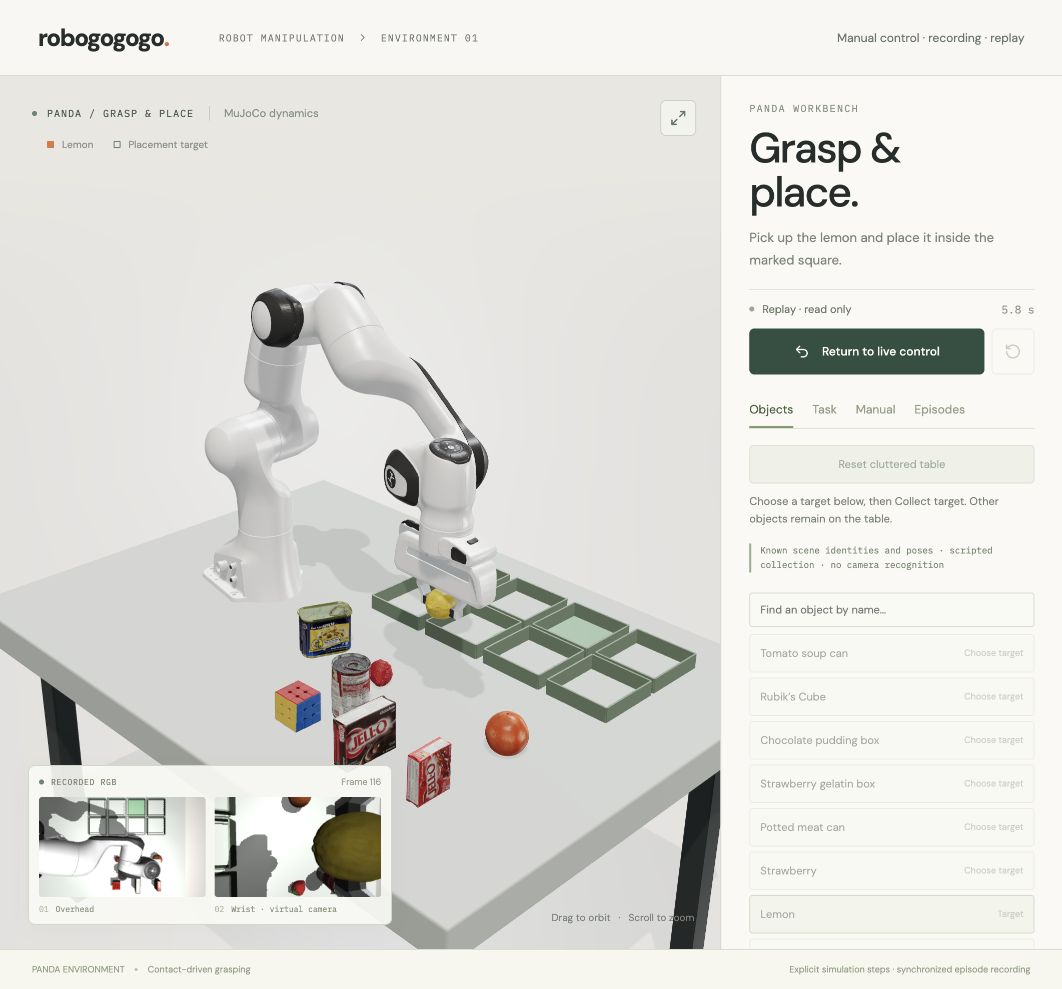
Load textured YCB models of household packages, fruit, and a Rubik’s Cube at their original scale. Each object has an independent rigid body and a collision model. Explore one object or put all eight on the table.
Select an object by name and use the scripted Panda controller to move it into its collection cell. Other objects stay in the physical scene. Choose another target to continue without resetting the table.
Use manual controls or the reference controller, record aligned overhead and wrist RGB with actions and physical state, and replay the scene frame by frame. Reset from a seed to restore the initial arrangement.
A Python and HTTP policy interface supplies the task instruction, camera images, and robot state, and accepts bounded robot actions. Object positions are excluded from policy observations. A learned model still needs to be connected and evaluated.
The current collector uses known scene identities and poses. Selecting “lemon” identifies a simulator object; it is not camera-based recognition. The policy interface is available for a future VLA, but learned perception, policy training, and physical robot evaluation are not included. Object masses and friction are assigned simulation parameters.
Start with the Panda grasp-and-place guide or the Studio walkthrough for the earlier RG Mobile Duo workspace, which remains separate. The updated paper, Robogogogo: A Tabletop Simulation Workbench for Object Collection and Policy Integration, by the Robo Team, describes the environment design, an illustrative scripted sequence, and the remaining evaluation questions.
Original project material © 2026 robogogogo contributors, licensed under Apache-2.0. Project notice. Pictured scans are from the YCB Object and Model Set (Calli et al., Google 16k variants) and remain under CC BY 4.0.